
Search no longer happens in one place.
A customer may ask ChatGPT a question, search Google, scan local maps, read reviews, watch a video, visit a social profile, and compare websites before contacting a business.
Search became a system.
That system needs clear answers, accurate business information, local relevance, useful content, and a consistent message across every customer touchpoint. Keywords remain important. Their value grows when they connect to real customer questions and a well-built digital footprint.
Is your website and marketing content ready for the way customers search now? Contact Fuller Creative to request a complimentary search visibility audit.
Many small to medium sized business owners are asking the same practical question: Why do we still need marketers when AI can help create content?
Businesses need experienced marketers
SEO, AEO, and GEO require strategy across websites, service pages, social media, local search, reviews, advertising, and the customer journey. AI can support research, ideation, drafting, and analysis. Human marketers turn those capabilities into clear answers, distinctive brand messaging, local relevance, trustworthy information, and a connected system that helps customers find, understand, and choose a business.
What Are SEO, AEO, and GEO?
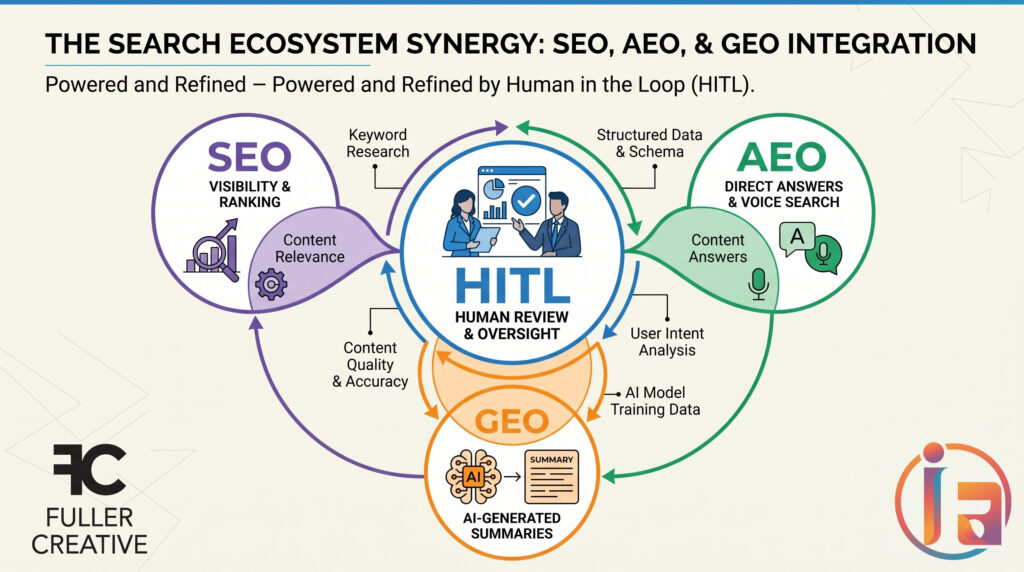
SEO, AEO, and GEO support different parts of modern search visibility.
SEO: Search Engine Optimization
SEO helps search engines understand what a page offers, who it helps, where the service is available, and when the page may be relevant.
It includes page structure, search terms, internal links, technical website health, local signals, useful content, metadata, accessibility, and site architecture.
SEO builds the foundation.
AEO: Answer Engine Optimization
AEO helps search platforms understand and respond to specific customer questions.
Customers increasingly search in complete thoughts: What does this service cost? Who provides it near me? What should I do first? How long will the process take?
AEO organizes content around those questions and places useful answers where people and digital systems can find them quickly.
AEO creates clarity.
GEO: Generative Engine Optimization
GEO helps generative AI systems understand a business, its services, its expertise, its location, and the customer situations it can address.
Clear service explanations, strong FAQs, consistent company information, credible proof, structured pages, and relevant local context give these systems better material to interpret and summarize.
GEO builds understanding.
Together, SEO, AEO, and GEO help a business become easier to find, easier to understand, and easier to trust.
The Digital Brochure Becomes a Search Assistant
Many business websites were originally built as digital brochures. They displayed a service list, a few photos, contact information, and a short company description.
That structure served an earlier search experience.
A modern website has a larger job. It needs to explain services, answer customer questions, support local searches, reinforce advertising, connect with social content, demonstrate credibility, and make the next step clear.
The website now acts like a search assistant for the business.
When a customer asks, “Who should I call?” or “What should I do first?” the website should provide a useful answer. A generic slogan leaves those questions unresolved. A keyword without context gives customers little reason to trust the result.
Your website needs to carry the conversation forward.
Why Does AI Search Matter for Local Businesses?
Local customers use several sources before making a decision.
Someone may discover a company on Facebook, confirm its location through Google Maps, read reviews, ask an AI tool about the service, watch a short video, and visit the website before making contact.
Every stop shapes the decision.
Customers want to know:
- What does this business do?
- Who does it help?
- Where does it provide service?
- Does it understand my problem?
- Can I trust its claims?
- What should I do next?
Scattered, outdated, or vague information creates friction. A clear and consistent digital footprint gives the customer confidence to continue.
For small to medium sized businesses, managing this system can become a serious operational burden. Owners already oversee staff, sales, scheduling, billing, customer service, and daily decisions. Modern visibility adds Google Search, AI search, maps, reviews, social platforms, service pages, blogs, paid ads, video, and analytics to the workload.
This is why marketing professionals matter.
A skilled marketer sees the whole system and gives each part a purpose.
Why Do Keywords Need Strategy?
Keywords help search engines connect a page with a relevant topic. They also reveal the language customers use when describing a service, problem, location, or decision.
Their meaning depends on context.
A service page can contain the right keyword and leave the customer’s question unanswered. A blog can attract traffic and fail to explain why the company is credible. A social post can mention the service and give the reader no useful next step.
Modern content needs to connect the search term to intent.
That means answering the question, explaining the service, reflecting the location, supporting the claim, and guiding the customer toward an appropriate action.
Keywords open the door. Strategy determines what happens next.
What Can AI Contribute to Search Marketing?
AI can help an experienced marketing team produce raw starting points for:
- Keyword and customer-question research
- Blog and service-page outlines
- FAQ ideas
- Social media caption drafts
- Google Business Profile post ideas
- Ad headline variations
- Landing page structures
- Video script drafts
- Content repurposing plans
- Campaign testing concepts
- Data summaries and reporting analysis
These tools can reduce production friction and help teams explore more possibilities.
Speed is not strategy.
Raw AI output often reflects common patterns, familiar phrases, and predictable structures. Businesses using similar tools and instructions can end up publishing similar material.
Sameness weakens recognition.
A polished paragraph has limited value when it lacks local context, customer insight, brand voice, accurate service details, and a clear next action. Human judgment turns a plausible draft into marketing the business can stand behind.
Why Is Human-in-the-Loop Strategy Essential?
At Fuller Creative, AI-powered tools support research, analysis, ideation, production, and refinement. Human intuition, professional experience, local market knowledge, creative judgment, and strategic editing guide the final outcome.
People remain responsible for the work.
Empathic and Human-First
Customers bring real goals, concerns, budgets, frustrations, and consequences to every decision.
Human marketers recognize the emotional contract between a business and its customers. They choose language that respects the situation, answers the concern, and gives the customer a reason to continue.
Locally Relevant
Local businesses serve actual communities with specific expectations.
For a Kansas City company, relevant content may need to reflect service areas such as Overland Park, Olathe, Lee’s Summit, Independence, the Northland, or the broader metro. The appropriate detail depends on the service and the customer’s question.
Local context should feel lived in.
Clear and Brand Consistent
A customer should recognize the same company across its website, social content, advertisements, videos, blogs, service pages, and Google Business Profile.
Human strategy keeps the voice, visual direction, claims, and calls to action aligned.
Useful and Search Ready
Content should help people understand the business and make a decision. Clear structure also helps search engines, answer engines, and generative AI platforms interpret the service, location, customer need, and next action.
Build for people. Structure for machines.
How Do SEO, AEO, and GEO Work as One System?
A strong service page can support all three disciplines.
Its SEO structure can identify the service, market, and page topic. Its AEO content can answer direct customer questions. Its GEO signals can explain the business role, service process, expertise, local relevance, and customer situation with enough clarity for generative systems to understand.
That page can then connect to:
- Related blog posts
- Social media content
- Google Business Profile updates
- Paid search campaigns
- Focused landing pages
- Customer reviews
- Video explanations
- Internal service links
- Conversion tracking
This is the connective tissue.
Good marketing gives each asset a job and connects it to the next step in the customer journey.
Why It Matters
- Visibility: Clear content gives search platforms stronger information about what the business offers and where it operates.
- Trust: Useful answers, consistent claims, local details, and credible proof help customers evaluate the company.
- Conversion: Aligned ads, pages, offers, and calls to action reduce friction between discovery and contact.
- Measurement: Accurate analytics and conversion tracking show which pages, searches, calls, forms, and campaigns produce opportunities.
- Ownership: A well-structured website, clean data, and owned brand assets give the business a durable marketing foundation.
This is where we unleash the power of boring.
Clear page names. Accurate business information. Working analytics. Clean internal links. Useful service descriptions. Consistent calls to action. These foundations rarely attract applause. They help the marketing produce results.
What Does This Mean for Small to Medium Sized Businesses?
Small to medium sized businesses compete for attention across search results, AI answers, ads, review platforms, social feeds, videos, directories, and maps.
Clarity becomes the advantage.
The business needs to explain what it does, who it helps, where it works, why it is credible, and what the customer should do next.
Small to medium sized business truth:
Your marketing should help people find you, understand you, and trust you before they ever contact you.
How Fuller Creative Builds a Connected Search System
Fuller Creative helps small to medium sized businesses create marketing for the way people search, compare, and make decisions now.
Phase 1: Build the Foundation
We review the website, brand position, service messaging, local signals, analytics, search visibility, customer journey, and calls to action.
This phase identifies gaps and establishes the facts every platform needs to understand.
Phase 2: Connect the Marketing System
We align SEO, AEO, GEO, website content, social media, Google Business Profile, paid advertising, landing pages, video, and brand storytelling around one strategy.
Each channel supports the next.
Phase 3: Measure and Refine
We track meaningful actions, evaluate performance, improve weak points, and build content around the questions customers actually ask.
AI-assisted tools can help the process move efficiently. Experienced professionals guide the direction and remain accountable for the outcome.
Is Your Marketing Ready for the Next Era of Search?
Website age alone does not determine search readiness. Readiness depends on clear messaging, useful answers, technical health, local relevance, structured information, connected customer journeys, and accurate tracking.
Fuller Creative can review how your business appears across your website, search presence, social platforms, advertisements, local listings, and customer journey.
Contact Fuller Creative to request a complimentary search visibility audit, or schedule a strategy session through Fuller Creative Zoho Bookings to review your digital footprint.
Frequently Asked Questions
What is the difference between SEO, AEO, and GEO?
SEO helps search engines understand and surface relevant pages. AEO helps platforms answer direct customer questions. GEO helps generative AI systems interpret, summarize, and potentially reference a business, service, location, and area of expertise.
Why do small businesses need AEO?
Small businesses need AEO because customers often search using complete questions. Direct, useful answers can help a business communicate clearly before the customer calls, books, visits, or compares providers.
Does AI replace a marketing agency?
AI supports research, drafting, analysis, testing, and production. A marketing agency supplies strategy, local knowledge, brand direction, quality control, integration across channels, and accountability for the final work.
Why are keywords no longer enough?
Keywords identify relevance. Modern visibility also depends on helpful answers, accurate service information, local signals, site structure, credible proof, internal links, and a clear customer journey.
How can Fuller Creative help with AI search?
Fuller Creative connects website messaging, SEO, AEO, GEO, social media, Google Business Profile, paid advertising, local visibility, analytics, and creative storytelling into one professionally directed marketing system.
Contact Fuller Creative to request a complimentary search visibility audit.