
Stop Posting, Start Answering: The Shift to Search-Driven Social Media in 2026
There was a time when social media for a small business meant posting a photo, writing a caption, adding a few hashtags, and hoping somebody noticed.
That version is fading and fading fast.
In 2026, social media is doing something bigger. It is becoming part of how people search. Customers are using TikTok, Instagram, YouTube, Facebook, Reddit, LinkedIn, and Google together.
They are watching videos, reading comments, checking profiles, comparing businesses, looking for proof, and asking the internet the same question every small business wants to answer:
Can I trust this company?
That changes the job of social media.
It is no longer only about showing up in the feed. It is about showing up when people are looking.
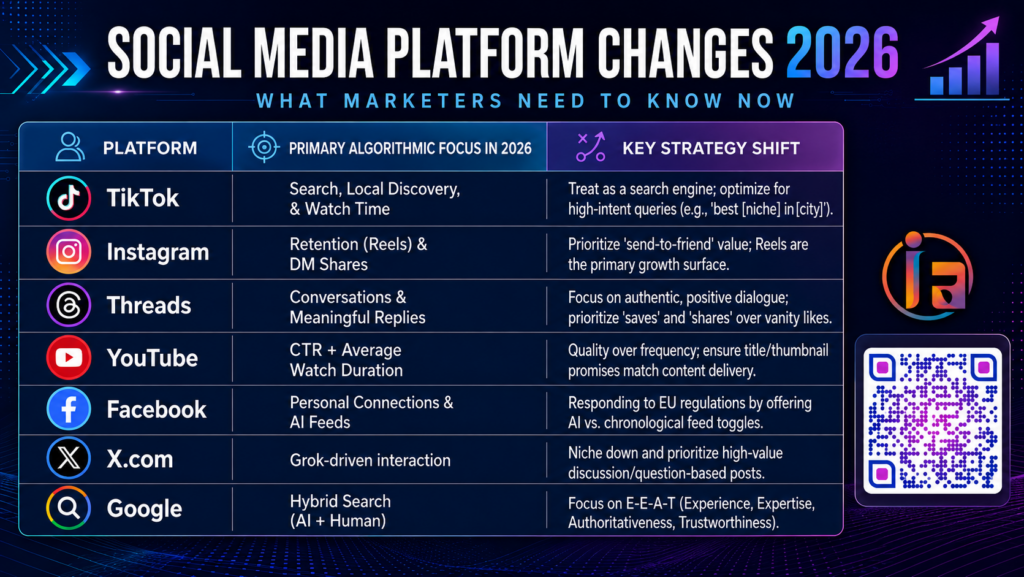
In 2026, the digital landscape has shifted from a “follow graph” to an “interest graph”—where AI serves content based on predicted relevance rather than just who you follow. Across all platforms, the universal currency is no longer the “like”; it is dwell time, completion rate, and shares.
Here is the updated breakdown of the algorithmic focus and strategic shifts for the major platforms as of June 2026.
1. Your social posts are becoming searchable assets
A social post used to feel temporary. You posted it. A few people saw it. Then it disappeared into the endless scroll.
That is not how it works anymore.
Social platforms are increasingly being used like search engines, especially by consumers looking for needs, products, and answers inside the platform itself.
That matters for small businesses because every caption, video title, profile bio, image description, Reel, Short, carousel, and comment thread can become part of how someone finds you.
For example:
- A plumber answering “Why does my drain smell?”
- A restoration company explaining “What to do after a basement flood.”
- A contractor showing “how to spot bad siding work.”
- A dentist explaining “why your gums bleed when brushing.”
Those are not only posts. They are searchable answers.
Small business truth:
Your content should answer the questions people are already asking.
2. Social media and SEO are starting to blend together
For years, small business owners thought of SEO and social media as two separate lanes.
SEO was the website. Social was the posting calendar.
That wall is coming down.
The way people discover content online HAS CHANGED, and
small businesses need to pay attention to the platforms they use and how they use them. Your social media is a major part of your company’s visibility,
discovery, engagement, and competitiveness now.
That’s a big shift. It means your social media should not be treated like filler between sales campaigns. It should support how people find you. You need to hire a marketer who not only understands SEO but also has a firm grasp on AEO.
A strong small business post should do three things:
- It should be useful.
- It should sound human.
- It should help the right customer recognize that you solve their problem.
That’s exactly where search and social meet.
Small business truth:
Social media is becoming part of your findability strategy.
3. You do not need to go viral to make social media work
Small business owners get sold a lot of bad mythology.
“Go viral.”
“Beat the algorithm.”
“Post every trend.”
“Do what the big brands are doing.”
Most of that advice is noise.
A local service business does not need a million strangers laughing at a trend video. It needs the right people in the right market to remember its name when a real need shows up.
Small businesses need to move toward visibility, engagement, and adapting to changing discovery behavior as AEO takes hold. This is the practical way to think about social media in 2026. Not fame. Not gimmicks. Just Visibility and Trust.
For a small to medium sized business, one useful video that answers a real customer question can be more valuable than a flashy post that attracts people who will never buy.
A good post might not explode. It might sit there quietly until someone searches for the exact thing you do.
That is the win.
Small business truth:
The goal is not to go viral. The goal is to be found, trusted, and
contacted.
4. The words you use matter more than ever
Social platforms are getting better at reading what your
content is about.
Instagram now reads caption text, on-screen text in Reels, keywords in comments, alt text, profile bios, and usernames. Platforms like Instagram, TikTok, and YouTube have become powerful search engines where content needs to show up when someone searches a question, topic, or phrase.
Businesses need to intentionally optimize social content because search and social are now connected discovery channels.
That means small businesses need to stop writing vague captions. They need to hire a local social media manager to make their local brand identity known.
A weak caption says:
Another job done. Call us today.
A stronger caption says:
Basement flooding in Kansas City can lead to water damage, mold growth, and structural problems if it is not handled quickly. Here is what to check first before cleanup begins.
That second caption gives the platform more context. It gives the customer more value. It gives search behavior something to grab onto.
The same applies to videos. Say the service out loud. Put the service on screen. Use the city name when it matters. Answer the question
clearly.
Small business truth:
Clear language helps customers and platforms understand what you do.
5. A posting calendar is not enough anymore
A calendar is useful. It keeps the machine moving.
But a calendar by itself is not strategy.
Social media management agencies now handle strategy, content creation, publishing, engagement, influencer partnerships, and reporting. The best agencies build integrated programs, not only posting calendars.
That is the line small business owners need to hear.
Posting three times a week means very little if the posts do not connect to anything. No customer questions. No service pages. No search intent. No local relevance. No proof. No measurement.
A real social media system should connect to:
- Website visits
- Phone calls
- Form fills
- Local visibility
- Search behavior
- Customer questions
- Reputation
- Before and after proof
- Trust signals
- Sales conversations
That does not mean every post needs to sell. It means every
post should have a job.
- Some posts build trust.
- Some answer questions.
- Some show proof.
- Some drive traffic.
- Some explain the service.
- Some make the business feel human.
Together, they create momentum.
Small business truth:
Social media management should be a business system, not a content chore.
6. Younger customers are already searching differently
This behavior shift is not theoretical.
Inside Higher Ed reported in April 2026 that many Gen Z students are using TikTok to search for scholarship information. The article also notes a real caution: users found opportunities, but they also encountered misinformation.
That is the modern search environment in one sentence.
People are searching on social platforms.
- They are finding useful things.
- They are also sorting through noise.
For small businesses, that creates a major opening.
If people are using social platforms to figure out what to do, who to trust, and what feels real, then your business has a job to do there. You do not need to sound like an influencer. You need to sound like a credible local business that knows what it is doing.
Small business truth:
Younger customers may search on social media before they ever land on your
website.
What this really means for small business owners
The old social media question was:
What should we post today?
The better 2026 question is:
What are our customers searching for, and does our content help them find us?
That changes everything.
A small business does not need to chase every trend. It needs a smarter content engine. One that uses customer questions, local search terms, service language, helpful videos, clear captions, strong profiles, and real proof.
Because the customer journey is not clean anymore.
Someone might see your Instagram post on Monday, search your service on TikTok on Wednesday, check Google on Friday, read your reviews, scan your Facebook page, watch a YouTube Short, then finally call next week.
That is not random. That is modern trust-building.
Final takeaway
Social media is becoming a search and trust layer for small businesses.
The businesses that win will not be the ones posting the loudest. They will be the ones answering real questions clearly, showing up consistently, and making it easy for customers to understand who they are, what they do, where they work, and why they can be trusted.
In 2026, social media management is not only about content.
- It is about being found.
- It is about being understood.
- It is about being chosen.